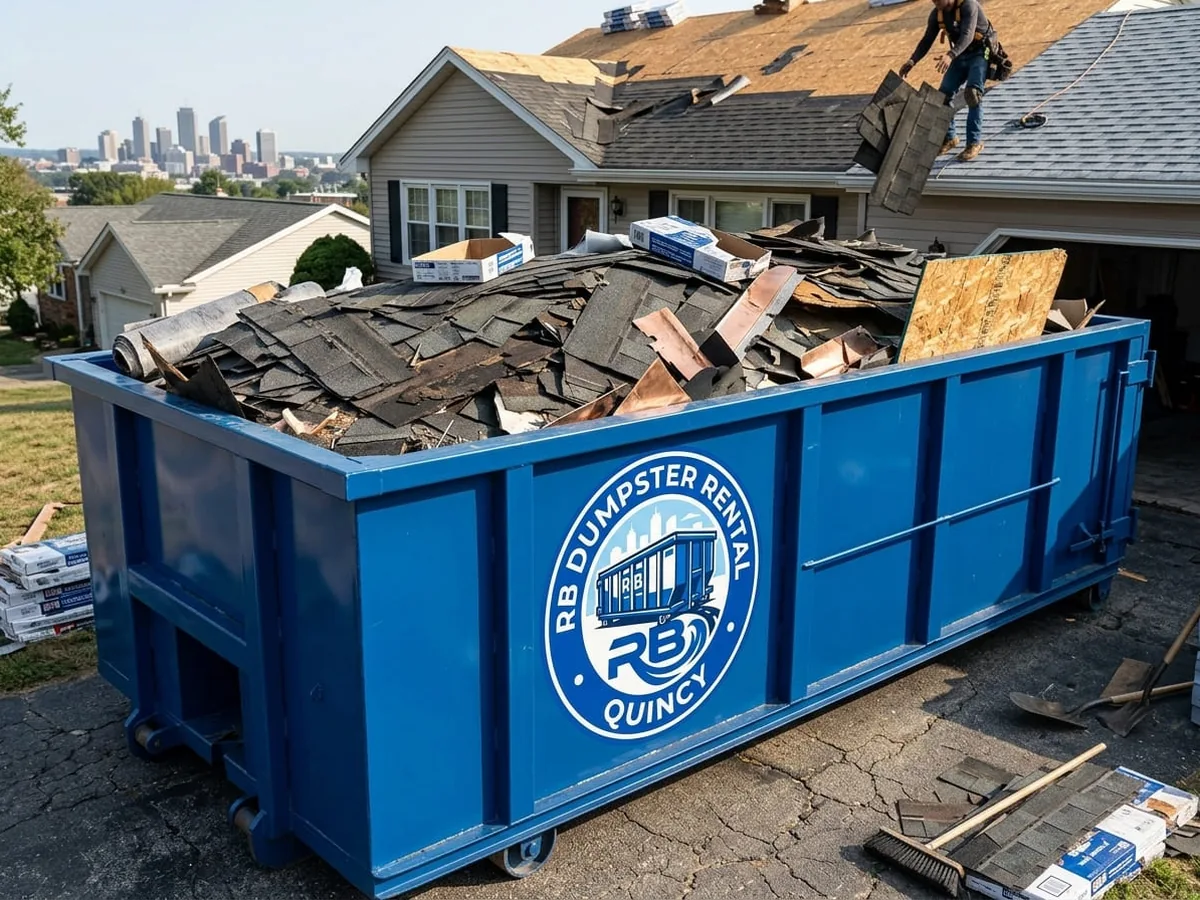

Mississippi River Flood Cleanup: A Quincy Property Guide
What to know about clearing water-damaged material fast after Mississippi River or spring flooding hits low-lying Quincy-area property.
ReadStorm Cleanup guide
From spring thunderstorms to winter ice storms, here's how to size a dumpster and sort debris after severe weather hits your Quincy-area property.

When a spring thunderstorm rolls off the plains and drops a line of straight-line wind through Adams County, or an ice storm coats every branch in the South Side German Historic District until it snaps, the first question isn't insurance paperwork or contractor bids — it's where all that debris is going to go. A properly sized dumpster is the fastest way to get storm debris off a Quincy-area property, and knowing what size to order and how to sort the pile can also save real money on an insurance claim.
West-central Illinois sees a real spread of severe weather across the year, and each type leaves a different kind of mess behind.
Any one of these can leave a Quincy homeowner or an outlying Adams County property with more debris than a household trash pickup can handle in a month, let alone a week.
Storm debris does not behave like ordinary household junk. Downed limbs and brush take up a lot of volume but don't weigh much; roofing and structural debris is the opposite — a modest-looking pile can be surprisingly heavy. Getting the size right up front avoids a mid-cleanup swap.
| Damage type | Typical size |
|---|---|
| Scattered limbs and yard debris, single property | 15 or 20 yard |
| Fallen tree, fence damage, or a small outbuilding | 20 or 30 yard |
| Roof tear-off after hail or wind damage | 20 or 30 yard, sized by roof square footage |
| Widespread tornado or derecho damage to a structure | 30 yard, often more than one container |
If you're not sure which container fits the job, our dumpster rental cost guide breaks down what drives price by size, and the crew can usually size a job over the phone once you describe what's on the ground.
One mistake we see constantly after a storm: everything gets thrown into one pile and hauled before anyone documents what happened. If a claim is on the table, a little discipline before the dumpster fills up goes a long way.
None of this is legal or insurance advice — check with your carrier on their specific documentation requirements — but photographing before hauling and keeping structural debris visually separate from yard waste is a habit that has saved plenty of Adams County homeowners a disputed claim.
Storm season in this part of Illinois runs heaviest from April through July, tapering into a second smaller wave when winter ice storms hit. When a big enough event rolls through the region, every hauler in west-central Illinois and northeast Missouri gets a wave of calls at once, and delivery slots tighten fast. A few things help:
Being based right in Quincy at 301 S 7th St means our trucks aren't staging from out of town when a storm rolls through — we're already positioned to reach Quincy, the surrounding Adams County villages, and Hannibal across the river without a long haul in either direction.
A few things need to be kept separate from a standard storm debris load, even when they show up mixed in with everything else: fuel or oil from a damaged generator or mower, propane tanks, and any downed material you suspect is treated lumber. If a roof tear-off turns up old shingles on a house built well before recent decades, ask before loading it — older roofing and siding material can carry asbestos and needs different handling. Our storm debris removal service is set up specifically for the mixed loads a storm typically produces, and the crew can flag anything that needs to be handled separately.
Once it's safe to be in the yard, call (217) 860-6534 and describe what's on the ground — downed limbs, roof damage, a collapsed outbuilding, or a combination. We serve Quincy and all of Adams County's villages plus Hannibal, Missouri, and during active storm stretches we prioritize getting a container out fast rather than making a property wait behind a long list. Rental pricing in the Quincy area typically runs $275 to $800 depending on size and how long you need the container, and we'll walk through that on the call so there are no surprises once cleanup starts.
Talk to a real person
Call (217) 860-6534 and describe the job. Flat price, stated tonnage allowance, and a delivery window on the same call.
Mon–Sat 7:00am – 7:00pm
From this guide
During an active storm stretch we prioritize same- or next-day delivery when road conditions are safe. Calling as soon as you can safely assess the damage, even before everything is sorted, helps us get a container on the schedule sooner.
It depends on the type. Downed limbs and brush are high volume but relatively light. Roofing, siding, and other structural debris from wind or hail damage is much heavier per cubic yard, so size for weight as well as volume when structural material is involved.
Photograph the damage first, but most insurers expect reasonable steps to prevent further damage rather than a property left untouched for weeks. Keep structural debris separated and documented, and check with your specific carrier on their requirements before a large cleanup.
City of Quincy municipal code allows a dumpster in the street or right-of-way when it's positioned to protect public safety. See our Quincy dumpster permit guide for the specifics, or ask when you book and we'll help make sure placement is compliant.
Keep reading
What to know about clearing water-damaged material fast after Mississippi River or spring flooding hits low-lying Quincy-area property.
ReadHow to size and schedule dumpster swaps by construction phase so a full container never stalls your crew on a Quincy-area build.
ReadRoofing debris is heavier and messier than people expect. Here's how to size, place, and time a dumpster for a roof tear-off anywhere in the Quincy area.
Read